Tuesday, November 13, 2012

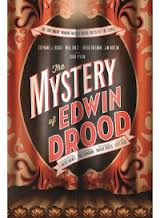
'The Mystery of Edwin Drood': Poised To Be First Hit of the Season


What a time it’s been lately, thanks in no small measure to Hurricane Sandy barreling  through the region. 

We watched from our third story window as the corrosive salt waters of the East River rose to a height of five feet outside our building, drowning every car in sight and wreaking havoc with everything else that lay in its path. In its wake, we were without electricity for ten days and still live with the mess. 

Yet we know full well how fortunate we have been when compared with those whose lives were turned upside-down, whose homes were badly damaged or even destroyed, and who still wait for relief.  Our warmest thoughts and wishes go out to all who have yet to begin to recover. 

Theatergoing was moved to a backburner, but getting back to this blog is part of my own effort to regroup.

After a slow start, and a temporary halt, I am happy to be able to report that Broadway may very well have its first bona fide hit of the season with the highly entertaining, exceptionally well-performed revival of The Mystery of Edwin Drood, a quirky musical that takes audience participation to new and delectable heights.

Drood, winner of multiple Tony Awards in1986 for its creator Rupert Holmes (best book, best music, best lyrics, best musical), is based on the unfinished novel of the same title by Charles Dickens, who died before completing it. It is the unfinished nature of the work that Holmes latched onto, and the thing that makes the show such a crowd-pleaser.

Because Dickens offers up a plot that is so convoluted and melodramatic as to defy any suspension of disbelief, there really are only two ways to play out the story:  straightforward or with tongue firmly planted in cheek.

If you saw the version that was shown on PBS’s Masterpiece Theater some months ago, you got an attempt at telling the story in a straightforward way.  The best that can be said about it is that you could more-or-less follow the tale through to the ending that the writer Gwyneth Hughes created for it. 

Fortunately for audiences in the Roundabout Theatre’s Studio 54, Mr. Holmes’s version is played as a pure romp, framed as a musical production by a company known as the Music Hall Royale.  

Under director Scott Ellis’s deft hand, the actors move in and out of their roles, sometimes portraying the characters in the melodrama The Mystery of Edwin Drood, sometimes stepping out of their roles to play directly to and with the audience.

I don’t quite know how to begin to explain the plot, but let me give it a shot. 

Young Edwin Drood and the sweet Rosa Bud have been engaged to be married almost since birth.  Edwin’s uncle John Jasper, who is also Rosa’s music tutor, is madly in love with his pupil and is consumed with jealousy.  To make matters worse, his mind is addled to the breaking point by the laudanum-infused wine to which he is addicted.

He is, assuredly, capable of doing great harm.  And, indeed, he becomes a prime suspect when Edwin goes missing and is presumed dead.  Yet is Jasper the villain he seems to be?

The story grows quite complicated as it turns into a whodunit, with tangential twists and turns galore, not to mention characters who show up and disappear for no apparent good reason.  

And while Jasper is the obvious suspect, there are others, especially Neville Landless, a Ceylonese native with a hot temper who has shown a serious dislike for Edwin and who was with him when he was last seen alive. 

Beyond that, at least plot-wise, I think I will step back and let you discover it for yourself.

Since the author left his story unfinished, there comes a point (announced in mid-song), where Dickens’s voice disappears and anything can happen.  Freed of the constraints of pre-determined plot points, the last 45 minutes is just jolly good fun.

Mr. Holmes has opted to let the audience vote on several key issues, including the identity of the murderer.  

This isn’t a shout-out vote, but an actual count of hands by members of the company, who spread out into the various sections of the audience so that every vote matters. 

In addition to choosing the killer, the audience determines the secret identity of one of the characters, and selects a pair of lovers to give the show its romantic/happy/comic ending. 

The game actors are first-rate through-and-through, with special nods to Will Chase as John Jasper, Stephanie Block as Edwin Drood (the role is written for a woman to play), Betsy Wolfe as Rosa Bud, Andy Karl as Neville Landless, Jessie Mueller as his sister Helena, and the incomparable Chita Rivera as Princess Puffer, proprietress of the opium den that John Jasper calls his home away from home. Kudos, too, to Robert Creighton, for his great comic turn as Durdles; the audience loves him.  
  
But if the show belongs to anyone, it is Jim Norton as the character known as Chairman.  Norton understands better than anyone on stage how to ringmaster a music hall production, how to win over an audience, and how to tell the corniest of jokes with the polished skill of a lifelong seller of blarney. 

Musically, The Mystery of Edwin Drood is definitely a mixed bag.  Many of the numbers are serviceable, if not memorable.  But there are enough winners to satisfy, including a wonderful patter song, “Both Sides of the Coin,” modeled on Gilbert and Sullivan, which Mr. Norton and Mr. Chase play off one another in a tongue-destroying way.  Other first-rate tunes include the haunting and creepy “Moonfall,” which Jasper has supposedly written for Rosa to sing; “The Wages of Sin,” performed by Ms. Rivera and which includes audience participation; and the triumphant “The Writing On The Wall,” sung by (sorry, it wouldn’t be cricket to tell you).

With multiple possibilities in Act II, the cast seems to be having a blast, and their pleasure is definitely contagious.  A shout-out needs to go, too, to the stylish contributions of choreographer Warren Carlyle, set designer Anna Louizos, and costume designer William Ivey Long.

At the start of this review, I noted that The Mystery of Edwin Drood may be the first hit of the season.  That does depend a lot on audiences showing up and participating. Studio 54 is a little off the tourist path, and, despite the success of its original run, not a lot of folks would have heard of the show.

So I’m suggesting another form of audience participation, which is this:  If you see it and like it, spread the word.  It will take word-of-mouth to keep the show going, especially now when things are at sixes and sevens post-Sandy.

So, go.  Enjoy.  And it’s OK to reveal all (except, perhaps, the final number), because every performance will have a different set of solutions.

Feel free to tell your friends about this blog, and to share your own theater stories by posting a comment.

Saturday, October 13, 2012

A Sucker Born Every Minute


You might remember one of the memorable episodes in Mark Twain’s Huckleberry Finn—the stunt pulled by the characters known as “the Duke” and “the King,” scam artists Huck runs into while rafting on the Mississippi.  

The pair rent out a theater and then advertise a performance of a show they call "The Royal Nonesuch," to which women and children are not to be admitted. Naturally, all of the men in town—expecting some X-rated action—buy up the tickets, only to learn they have been hoodwinked when all they get for their money is the sight of “the King” prancing in his birthday suit across the stage. 

Tonight, I felt like one of Mr. Twain’s suckers. 

I attended what was advertised to be a performance of Tennessee Williams’ seldom-produced play, In the Bar of a Tokyo Hotel, at the New World Stages.  I am a long-time admirer of Williams’ work and welcomed the opportunity to see this play about an artist barely clinging to his sanity.   

So…the audience is sitting there 15 minutes past curtain time, with nothing but a makeshift set suggestive of a bar to look at, when out bounces someone who introduces herself as Maria Torres, the director/choreographer. 

Ms. Torres announces that they will be unable to perform the play because a member of the cast was not able to go on (whether due to sickness or injury was unclear, at least to me).  However, she didn’t want us to leave empty-handed; instead she wanted to share with us a bit of what it was we would have seen if we had, indeed, seen it. 

She awkwardly read aloud a couple of paragraphs from the program and explained how they had intended to embellish the play with bits of choreography and works of art to make the production more multi-dimensional (as if Tennessee Williams were incapable of accomplishing this through his use of language).  She then brought out a couple of performers who gave us two very brief segments of under-rehearsed (improvised?) choreographed movement. 

The whole thing lasted perhaps ten minutes, including a very lengthy pause between the first and second fragment. 

And that was it.  Ms. Torres sent us on our merry way, expressing the hope that we had been sufficiently intrigued to come back when things were up and running. 

Members of the audience were dumbfounded.  And no one on the staff at New World Stages would take any responsibility for this fiasco, which they were surely aware of long before we all showed up. One couple I spoke with said they had understood the actors would be performing with scripts in hand.  I also overheard someone else saying some ticketholders had been contacted earlier in the day about the pending cancellation.  

In any event, we were marched out to the exit without so much as a sheepish apology—much less the offer of a refund or rain check. 


I must say, in over fifty years of theatergoing, I’ve never experienced anything like this.  Yes, there have been canceled shows, but these have always been accompanied with apologies and refunds or tickets for another performance.   

Not this time. 

Caveat Emptor, everyone!

Feel free to tell your friends about this blog, and to share your own theater stories by posting a comment.

Sunday, October 7, 2012

Slow and Uninspired Start to the Fall Theater Season...But Let Us Be Hopeful


I'm back after a lengthy break precipitated in part by an onslaught of work-related demands on my time, and in part by the lackluster start to the fall theater season.  I'll not bore you with the details of the former, but let's do talk about the latter.

Late summer and early fall are generally slow times for New York theater, but this season is getting off to a particularly lurching and sluggish beginning, with little yet to excite the heart and soul of this intrepid theatergoer. 

At least in the summer, you’ve got the opportunity to take some exploratory risks by attending any of the dozens of new and potentially exciting works that are showcased in the various Off Broadway and Off Off Broadway fringe events.

I was happy to venture a bit off the beaten track on the off chance of discovering a new voice or acting talent, without the downside of having to spoon out buckets of money to do so.  I rather admired Hadrian’s Wall by Dani Vetere, Pieces by Chris Phillips, and June and Nancy by Michelle Ramoni.  All three works offered interesting, honest, and unexpected perspectives on LGBT themes.  On the lighter side, I also thoroughly enjoyed the musical How Deep Is the Ocean by the brother/sister team of Peter and Pia Cincotti. I hope all of these will live long and prosper in future productions.

But summer is over.  It’s October.  There is a chill in the air.  And I wait.

Maybe I was spoiled by last year’s kickoff to the fall season, when we were blessed early on with two amazing productions that got things rolling with a bang.  First there was the revival of Terrence McNally’s Master Class, starring Tyne Daly in a Tony-worthy performance as opera diva Maria Callas.  Then came the magnificent full-scale and starry production of Stephen Sondheim’s masterwork, Follies.  We were also privileged to see a mesmerizing  performance by Frank Langella in a revival of Terrence Rattigan’s Man and Boy, a production of a seldom-seen early Lanford Wilson play (Lemon Sky), and new and interesting works by rising playwrights Itamar Moses (Completeness) and Kirsten Greenidge (Milk Like Sugar). 

But this fall, the season seems to be dragging itself forward in a particularly uninspired and awkward manner.  The biggest news thus far has been the still-unraveling cautionary tale of intrigue and possible fraud surrounding the efforts to finance the on-again, off-again production of the musical version of Daphne du Maurier’s Rebecca

I just can’t get myself worked up to see the truncated version of Ibsen’s An Enemy of the People, or the tepidly-reviewed Chaplin (even though I think its star, Rob McClure, is tremendously talented), or even the fiftieth anniversary production of Who’s Afraid of Virginia Woolf? (didn’t we see a fine production of this, like ten minutes ago, with Kathleen Turner and Bill Irwin?).

So what have I liked lately?  Off Broadway does have some good options.  Detroit, The Exonerated, and If There Is I Haven’t Found It Yet are all well worth seeing.  

And despite my current lack of enthusiasm, I am looking forward to several forthcoming shows, including The Heiress (with Jessica Chastain and Downton Abbey heartthrob Dan Stevens), The Anarchist (David Mamet's new play, starring Patti LuPone and Debra Winger), The Mystery of Edwin Drood (with Chita Rivera, Will Chase, Jim Norton), and a production of Tennessee Williams's In the Bar of a Tokyo Hotel. 

Hey, I'm getting excited just writing about it.  

Who knows? Maybe it will turn out to be a great fall season after all!


Feel free to tell your friends about this blog, and to share your own theater stories by posting a comment.

Friday, August 17, 2012

FringeNYC, Week 1: "I Heart Revolution" and "Hadrian's Wall"

FringeNYC Begins:  187 Shows in 16 Days


Are you suffering from Olympics withdrawal? 

Here’s a cure for you:  Tackle the theater marathon that is FringeNYC, the International Fringe Festival.  187 shows, 19 venues, 16 days. Winner take all!

There is no way this couch potato is going to even try to see more than a few of the offerings (for one thing, my fulltime day job tends to get annoyingly in the way), but I did get to see a couple of the shows during the opening week.

Let’s begin with an offbeat comedy called I Heart Revolution, on view at the Living Theatre, with several more performances scheduled up to the festival’s final day, August 26.

I Heart Revolution is a gentle satire that takes aim at the “Occupy” movement; young revolutionaries, it would seem, have short attention spans and are easily distracted. 

In this case, the young revolutionaries are three BFFs—20-something children of privilege named Alexandra (the ditzy one), Tara (the belligerent one), and Alice (the sometime-peacemaker, sometime-pouty member of the triumvirate).  Back in the 1960s, we used to call them “Bonwit Teller hippies,” engaging in anti-war demonstrations and railing against the government during the week, while living off their trust funds and spending weekends with their families in the Hamptons. 

In I Heart Revolution, we are the proverbial “captive audience,” being held hostage by the trio. They surround us with police tape and hold us at bay with staple guns while they fill our heads with the not-quite-coherent beliefs they latched onto as students of a feminist professor at Brown University, a woman they refer to reverently as “Mother.”  

In what appears to be a semi-improvised event (though I Heart Revolution dates to 2008 and the aforementioned Brown University), the trio launches into a combination of diatribe, Power-Point presentations, threats, and New Age rituals aimed at getting us to succumb to Stockholm Syndrome.  That’s the phenomenon that occurs when hostages begin to empathize with their captors (à la Patty Hearst, the heiress and socialite who turned bank-robber after being taken hostage—a very real and non-satirical event). 

The (possibly unintended) irony is, you probably can empathize with the anger and frustration, of which there is a lot going around these days.  But, like a character in a Samuel Beckett play, the rage dissipates when our captors—given a forum to air their grievances—are unable to articulate exactly what it is they are enraged about or what they want to see happen. 

This is the point, it would seem, of I Heart Revolution, and, in the end, it is not surprising that things fall apart over an argument in which one of the characters is deeply offended at an off-hand remark about the singer Beyoncé.

Throughout the performance, the trio is aided and abetted in their efforts by a game Chris Lowell (“dumb as a bag of bricks but cute in shorts,” as one of the women describes him).  Lowell plays Michael, their put-upon gofer who is just happy to have even a tiny moment before an audience, even a captive one.  (In a funny bit that occurs when the three women have momentarily left the room, Michael auditions for us as Biff in a scene from Death Of A Salesman).

The tacky staging and cheap props are most appropriate for a fringe production, and the three playwright/performers—Alexandra Panzer, Tara Schuster, and Alice Winslow—are on to something here.  With a bit more satirical bite, more in-your-face scariness aimed at the audience (hey, they are performing at The Living Theatre after all), and perhaps the excising of 15 minutes or so, I Heart Revolution could very well have an afterlife. 

                        *                      *                                           

The second fringe show I saw last week is called Hadrian’s Wall (playing at the Connelly Theatre, with a last performance scheduled for this Sunday).  Unlike I Heart Revolution, this is a more fully realized play, written by Dani Vetere and directed by Stephen Cedars. 

Hadrian’s Wall is a three-character study about a brilliant yet reclusive archeologist named Ramona (Laura Siner).  Ramona has spent the last fifteen years holed up in her apartment after being accused of stealing an important artifact—a block of stone containing a tantalizing yet nearly indecipherable inscription she believes will lead to a significant breakthrough regarding the very real Roman Ninth Legion, about which a mystery remains to this day. 

Ramona is somewhat of a mystery herself, and the playwright slowly and carefully unearths fragments of her story and reveals them to us as an archeologist might, by dusting off the past and allowing us to learn about her life through her interactions with David (Eric Rolland), her attorney, friend, and former lover, and with a student at the university, Amy (Rebecca White), who is gradually supplanting David in Ramona's life.  

This is an intriguing play that leaves many questions unanswered, challenging us to interpret events for ourselves.  Taken at face value, Hadrian’s Wall is a straight-forward psychological mystery.  But its real strength is in what is left unrevealed.  There is more than a bit of Harold Pinter in the script; we are not meant to know everything, but we are invited to interpret. 

Perhaps the title is meant to suggest the self-protective wall that Ramona has built around herself since leaving the university.  Perhaps David and Amy exist only in Ramona’s memory, or perhaps she has invented one or both of them to keep her company in her self-imposed solitude.  One thing for sure, there is something about her that sticks in the mind and leaves you wanting to know more. 

I suspect that Hadrian’s Wall will have a further life, and that Dani Vetere will have an interesting future as a playwright.  But if you want to catch it now, you’ve only got until this Sunday. FringeNYC waits for no one!

If you crave more of ProfMiller, check out ProfMiller@The Theater at BroadwayShowBiz.com.  Most recent review posted there:  "Richard III."
  

Sunday, August 5, 2012

'Gore Vidal's The Best Man' Is a Fitting Tribute to Its Playwright


The candidates face off in 'Gore Vidal's The Best Man'


I am writing this review shortly after the lights of Broadway were dimmed in a salute to the late Gore Vidal—author, playwright, and raconteur—who passed away earlier this week at the age of 86. 

As it happens, I had a ticket to see the Broadway revival of Gore Vidal’s The Best Man the day after he died. The performance, under the able hand of director Michael Wilson, was dedicated to the playwright, and I am pleased to report that this production is a most fitting tribute to the Mr. Vidal’s memory and to his talent.  

Any play that is tied to a specific era will carry with it a bit of stale air, but the current cast, which includes several replacements since the show’s opening four months ago, burnishes every corner of this 1960 political melodrama so that it fairly gleams. 

The Best Man takes place during a presidential nominating convention, at a time when the selection of the party’s candidate was not the foregone conclusion it has become through the well-oiled primary election system. 

Enter the Schoenfeld Theatre, and it is as if you were a delegate to that convention.  As ushers wearing red, white, and blue beribboned straw hats lead you to your seat, you can see that the walls are festooned with bunting, placards, and posters, and there are television monitors suspended from the ceiling showing black-and-white images of the goings-on.

The audience can hear the sounds of speeches and of clapping and cheering that draw us in even before the play begins.  The convention takes place over three days, and at the start of each of the three acts, the sounds grow louder and more excited, helping us to feel the suspense of the battle among the three leading candidates.

The actual 1960 Democratic Convention—in which John Fitzgerald Kennedy emerged as the winner—is the first one that I can recall.  I was a young teenager at the time, and I remember being glued to the television, utterly fascinated with the entire process.  Vidal (who anointed himself a member of the Kennedy clan through a stepfather he had in common with Jacqueline Kennedy) clearly drew some of his plot elements from that convention, and it is the mix of history and an unfortunately prophetic vision of what the system has become in the years since then that continues to keep the play interesting. 

On the one hand, you have characters who bring to mind the charismatic Kennedy and the intellectual Adlai Stevenson, along with specific references to President Eisenhower, to his wife Mamie Eisenhower and even to Grace Coolidge, wife of President Calvin Coolidge.   These references, among others, remind us of the place and time the play inhabits.  But there is also a great deal of political gamesmanship, deal brokering, backstabbing, mudslinging, and dirty tricks, all of which will be very familiar even to those who are too young to recall the “good old days.”

The assumption we are handed is that the nomination will go to one of two candidates, the young, dashing, and ambitious Senator Joseph Cantwell (John Stamos) for whom the ends always justify the means, or the former Secretary of State William Russell (John Larroquette), a serious statesman who is a reluctant player in the game of politics. 

Each of the two bears a piece of information about the other that may be enough to break the stalemate.  Cantwell has learned of his opponent’s one-time bout with mental illness, and Russell has information that the Senator may have had a homosexual relationship while serving in the military.  The difference here is that Cantwell relishes his weapon and has already prepared copies of the medical report to distribute to the delegates, while Russell really wants nothing to do with raising potential destructive personal information. 

As the two circle one another, a third major player is on hand—former President Art Hockstader (magnificently portrayed by James Earl Jones), whose endorsement both candidates are seeking. Hockstader, presumably modeled on Harry Truman, is gravely ill, but he will not give up one moment of the spotlight he is enjoying as long as he withholds his endorsement, and his glee is palpable during his meetings with the two frontrunners, even after he can no longer manage to stand up. 

These three gentlemen are fascinating to watch.  John Stamos and John Larroquette embrace their roles nearly as gloriously as Mr. Jones.  But this is not a three-character play;  there are 22 characters, each of whom contributes mightily to keeping things jumping, forestalling any mustiness that might otherwise have crept in. 

Mr. Stamos only recently stepped into the part of Senator Cantwell (replacing Eric McCormack), and he has made it his own by supplying equal parts of boyish charm and Machiavellian underhandedness.  He is joined by three other newcomers:  Kristin Davis, replacing Kerry Butler and making an auspicious Broadway debut, as Cantwell’s ebullient wife; Cybill Shepherd, replacing Candice Bergen as Russell’s estranged wife and reluctant political partner; and Elizabeth Ashley as Sue-Ellen Gamadge, leader of the Women’s Division. 

Ms. Shepherd has quickly found her way into an underwritten part as a politico wife who gradually comes to embrace her public duties, and Ms. Davis and Ms. Ashley (who has the daunting privilege of following Angela Lansbury), absolutely shine in their respective roles.  Ms. Ashley, in particular, seems to have been born to play the role of the honey-toned yet razor-sharp piece of work that is Sue-Ellen Gamadge, who greets Cybill Shepherd’s character (who, after all, may wind up being First Lady) with these charming words:     


You…couldn’t…look…better!  I mean it!  
 I like the whole thing…especially the 
 naturally gray hair.

Even in the smaller roles, you get to see such talented actors as Mark Blum as Russell’s frustrated campaign manager, Dakin Matthews as a backslapping Southern senator, and the always-wonderful Jefferson Mays as the craven supplier of the gossip about Senator Cantwell’s alleged sexual misconduct. 

I’m not going to argue that The Best Man is the find of the century, but there is nothing also-ran about its Tony nomination for Best Revival of a Play (it lost to Death of a Salesman).  Smart directing by Michael Wilson and a top-notch company of actors makes it a sure-fire audience pleaser that I am happy to recommend without reservation.  


If you crave more of ProfMiller, check out the column, ProfMiller@The Theater, at BroadwayShowBiz.com.  Recent reviews include "How Deep Is The Ocean?," "Triassic Parq The Musical," and "Closer Than Ever."