What
a time it’s been lately, thanks in no small measure to Hurricane Sandy
barreling through the region.
We
watched from our third story window as the corrosive salt waters of the East
River rose to a height of five feet outside our building, drowning every car
in sight and wreaking havoc with everything else that lay in its path. In
its wake, we were without electricity for ten days and still live with the
mess.
Yet
we know full well how fortunate we have been when compared with those whose
lives were turned upside-down, whose homes were badly damaged or even
destroyed, and who still wait for relief. Our warmest thoughts and wishes go out
to all who have yet to begin to recover.
Theatergoing
was moved to a backburner, but getting back to this blog is part of my own
effort to regroup.
After
a slow start, and a temporary halt, I am happy to be able to report that
Broadway may very well have its first bona fide hit of the season with the
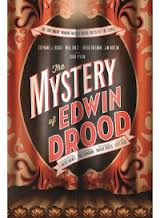
highly entertaining, exceptionally well-performed revival of The
Mystery of Edwin Drood, a quirky musical that takes audience participation
to new and delectable heights.
Drood, winner of multiple Tony Awards in1986 for its creator Rupert
Holmes (best book, best music, best lyrics, best musical), is based on the
unfinished novel of the same title by Charles Dickens, who died before
completing it. It is the unfinished nature of the work that Holmes latched
onto, and the thing that makes the show such a crowd-pleaser.
Because
Dickens offers up a plot that is so convoluted and melodramatic as to defy
any suspension of disbelief, there really are only two ways to play out the
story: straightforward or with tongue firmly planted in cheek.
If
you saw the version that was shown on PBS’s Masterpiece Theater some months
ago, you got an attempt at telling the story in a straightforward way.
The best that can be said about it is that you could more-or-less follow the
tale through to the ending that the writer Gwyneth Hughes created for it.
Fortunately
for audiences in the Roundabout Theatre’s Studio 54, Mr. Holmes’s version is
played as a pure romp, framed as a musical production by a company known as the
Music Hall Royale.
Under
director Scott Ellis’s deft hand, the actors move in and out of their roles,
sometimes portraying the characters in the melodrama The Mystery of
Edwin Drood, sometimes stepping out of their roles to play directly to and with the audience.
I
don’t quite know how to begin to explain the plot, but let me give it a
shot.
Young
Edwin Drood and the sweet Rosa Bud have been engaged to be married almost since
birth. Edwin’s uncle John Jasper, who is also Rosa’s music tutor, is
madly in love with his pupil and is consumed with jealousy. To make
matters worse, his mind is addled to the breaking point by the laudanum-infused
wine to which he is addicted.
He
is, assuredly, capable of doing great harm. And, indeed, he becomes a
prime suspect when Edwin goes missing and is presumed dead. Yet is Jasper
the villain he seems to be?
The
story grows quite complicated as it turns into a whodunit, with tangential
twists and turns galore, not to mention characters who show up and disappear
for no apparent good reason.
And
while Jasper is the obvious suspect, there are others, especially Neville
Landless, a Ceylonese native with a hot temper who has shown a serious dislike
for Edwin and who was with him when he was last seen alive.
Beyond
that, at least plot-wise, I think I will step back and let you discover it for
yourself.
Since
the author left his story unfinished, there comes a point (announced in
mid-song), where Dickens’s voice disappears and anything can happen. Freed of the constraints of pre-determined plot points, the last 45 minutes is just
jolly good fun.
Mr.
Holmes has opted to let the audience vote on several key issues, including the
identity of the murderer.
This isn’t a shout-out vote, but an actual
count of hands by members of the company, who spread out into the various
sections of the audience so that every vote matters.
In
addition to choosing the killer, the audience determines the secret identity of
one of the characters, and selects a pair of lovers to give the show its
romantic/happy/comic ending.
The
game actors are first-rate through-and-through, with special nods to Will Chase
as John Jasper, Stephanie Block as Edwin Drood (the role is written for a woman
to play), Betsy Wolfe as Rosa Bud, Andy Karl as Neville Landless, Jessie
Mueller as his sister Helena, and the incomparable Chita Rivera as Princess
Puffer, proprietress of the opium den that John Jasper calls his home away from
home. Kudos, too, to Robert Creighton, for his great comic turn as Durdles; the
audience loves him.
But
if the show belongs to anyone, it is Jim Norton as the character known as
Chairman. Norton understands better than anyone on stage how to
ringmaster a music hall production, how to win over an audience, and how to
tell the corniest of jokes with the polished skill of a lifelong seller of
blarney.
Musically,
The Mystery of Edwin Drood is definitely a mixed bag. Many of the numbers
are serviceable, if not memorable. But there are enough winners to
satisfy, including a wonderful patter song, “Both Sides of the Coin,” modeled
on Gilbert and Sullivan, which Mr. Norton and Mr. Chase play off one another in
a tongue-destroying way. Other first-rate tunes include the haunting and
creepy “Moonfall,” which Jasper has supposedly written for Rosa to sing; “The
Wages of Sin,” performed by Ms. Rivera and which includes audience
participation; and the triumphant “The Writing On The Wall,” sung by (sorry, it
wouldn’t be cricket to tell you).
With
multiple possibilities in Act II, the cast seems to be having a blast, and
their pleasure is definitely contagious. A shout-out needs to go, too, to
the stylish contributions of choreographer Warren Carlyle, set designer Anna
Louizos, and costume designer William Ivey Long.
At
the start of this review, I noted that The Mystery of Edwin Drood may
be the first hit of the season. That does depend a lot on audiences
showing up and participating. Studio 54 is a little off the tourist path,
and, despite the success of its original run, not a lot of folks would have
heard of the show.
So
I’m suggesting another form of audience participation, which is this: If
you see it and like it, spread the word. It will take word-of-mouth to
keep the show going, especially now when things are at sixes and sevens
post-Sandy.
So,
go. Enjoy. And it’s OK to reveal all (except, perhaps, the final
number), because every performance will have a different set of solutions.
Feel free to tell your friends about this blog, and to share your own theater stories by posting a comment.


