Sunday, February 10, 2013

A Joyous Revival of 'Talley's Folly' to Warm the Heart on a Cold Winter's Day


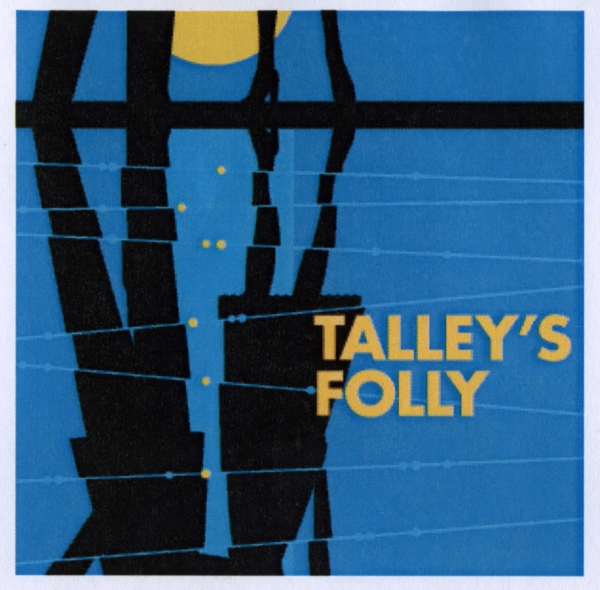
What a lovely Valentine’s Day gift the Roundabout Theatre Company has given us with its tender and emotionally rewarding revival of Lanford Wilson’s 1979 gem-of-the-heart, Talley’s Folly, now in previews at the Laura Pels under the delicately balanced direction of Michael Wilson.

It’s not hard to see why Matt Friedman, played here by Danny Burstein with a complicated mix of chutzpah and underlying schlubiness, has set his cap for Sally Talley.  As richly brought to life by a marvelous Sarah Paulson,  Sally is his equal in every way, the only woman in his 42 years who has captured his heart, despite the minor inconvenience of having shown no hint of interest in doing so.  

Matt and Sally are an unlikely pair.  Neither eHarmony nor JDate would think to bring them together, and it is a tribute to the playwright’s skills that, even though we know this story must have its happy ending (Matt assures of this in a prologue addressed directly to the audience), we remain unsure until the very end.  For though Matt—as narrator—draws us into the story as if embarking on a fairy tale, he and Sally are as real as two humans ever to emerge from a playwright’s imagination.

The tale unfolds on the evening of July 4, 1944 and takes place in a boathouse on the Talley family property in Lebanon, Missouri.  The boathouse is the literal “folly,” of the title, a folly being a fanciful structure meant to suggest a romantic old ruin, lovingly created for this production by set designer Jeff Cowie. 

Matt has come from St. Louis to convince Sally, with whom he had a brief romantic fling the previous year, to run off with him.  The distance from St. Louis to Lebanon is under 200 miles as the crow flies, but these two places are truly world’s apart.  Matt lives in a city where he can fit in comfortably as a Jewish immigrant accountant with socialist sympathies.  In Lebanon, though, he stands out like a sore thumb, a “traitor and an infidel,” as he puts it.

Sally, on the other hand, has grown up in a well-situated conservative Protestant family.  She carries a heavy burden of expectations that would make it unlikely that she would get together with someone like Matt, who, in addition to the obvious, is also 11 years her senior, and whose very presence has led Sally’s brother to chase him from the house with a shotgun.    

The audience’s joy of watching these two play off one another is in seeing the gradual peeling away of surface expectations.  Life has left both of them very wary and attuned to how best to navigate their way through the world with a careful projection of an image.  Matt hides behind his humor and charm; Sally hides behind her sense of dignity and professionalism (she is well regarded for her work as a nurse’s aide).   

It is Sally who eggs Matt into revealing his painful family history, which he does in his inevitable story-telling fashion. But the story he tells--one that is quite touching—unexpectedly triggers a strong negative response in Sally.  She doesn’t buy a word of it and believes she is being manipulated, something she will not countenance. 

In due time, we come to understand her reaction, and by the end, Matt and Sally have come to understand one another, and their love is solidified.  But as much as we appreciate our happy ending, Mr. Wilson’s great skill as a playwright is in painting complete portraits of Matt and Sally—and even of the members of their respective families whom we have come to know without having ever met them.

Issues of war, bigotry, unionism, and the constricted role of women are all addressed over the course of a seamless evening.  So, yes, this is a wonderfully romantic story, but there is not a moment of schlock or falseness in it. Talley's Folly is a love story for grown-ups and a Valentine to cherish.

Feel free to tell your friends about this blog, and to
share your own theater stories by posting a comment.

Thursday, January 17, 2013

'Cat On A Hot Tin Roof': Another Tepid Revival


If you want to get a sense of why Cat On A Hot Tin Roof is considered to be one of Tennessee Williams’s great accomplishments as a playwright, you might be better served by bypassing the current Broadway production and reading a copy of the script instead. 

This is a play that needs a deft hand at the helm, someone who can guide the actors into making subtle and unexpected changes in tone and mannerisms. Despite the grand themes the play wrestles with, at its heart this is a domestic drama.  As members of the audience, we must feel we are eavesdropping on some very painful and personal conversations between husband and wife and between father and son.  These moments of rare honesty occur in short outbursts, a sudden dropping of masks while playing out expected and well-practiced roles. It’s not for nothing that “mendacity” is one of the recurrent themes.      

A current example of how this kind of directing can be seen to powerful effect is in Ruben Santiago-Hudson’s handling of August Wilson’s The Piano Lesson at Signature Theatre.  There the audience is privy to some very private and deeply moving conversations that occur unexpectedly and with little fuss. It is because they are unexpected that we feel their power. 
 
But the director of Cat On A Hot Tin Roof, Rob Ashford, is best known for his work as a choreographer and director of musicals—big numbers, big moves, lots of bombast.  There is no subtlety to this overly busy and noisy production, and the shadings and shifts in tone are completely lost. 

In addition, it is essential to have the right actors in the key roles of Margaret (“Maggie the Cat”) and of Big Daddy.  Each of these characters dominates a complete section of the play. 

Act I belongs to Maggie, who has dragged herself up from poverty and has married into a very wealthy family, lorded over by her father-in-law, Big Daddy.  Maggie’s husband Brick has fallen into a state of alcoholism and self-loathing, and blames Maggie for most of his problems.  The two have not shared a civil conversation or a bed for some time, but are now staying at the family manse to honor Big Daddy on his 65th birthday.

Maggie is in their bedroom getting changed and trying to make conversation with her taciturn husband, who has broken a leg and has been holing himself in the room the whole evening, trying to drink himself into a stupor, the “click” that will bring him peace.

In the script of the play, Williams describes Maggie as “a pretty young woman, with anxious lines in her face…[with a] voice [that] is both rapid and drawling.  In her long speeches, she has the vocal tricks of a priest delivering a liturgical chant…”

As played by Scarlett Johansson, unfortunately, the best we can say about her is the opening phrase; she is a pretty young woman.  Now, Ms. Johansson really can act; she did splendidly in the brilliant production of Arthur Miller’s A View From The Bridge a couple of years back and walked away with a Tony Award for her efforts.  But she is unable to pull off the role of Maggie the Cat, in whom we need to see the mix of sultriness, intelligence, hunger, and ambition that Vivien Leigh gave to Ms. Johansson’s namesake, that other Scarlett in Gone With The Wind

By design—and because the only other person in the room has precious little to say—Maggie has to own Act I.  Her speeches need to encompass twittery filling-in-the-silent-spaces chit-chat and then shift, with just the right timing and tone, for what should be gaspingly stunning lines, like this one:  “I’m not living with you.  We occupy the same cage.” 

She also has one of the great exit lines of all time, in response to Brick’s sarcasm:

BrickHow on hell on earth do you imagine that you’re going to have a child by a man who can’t stand you?

MaggieThat’s a problem that I will have to work out.

Unfortunately, while the lines may be stunning, Ms. Johansson’s performance isn’t. Indeed, I was rather sympathetic to Benjamin Walker’s exasperated, passive aggressive portrayal of Brick, as his wife rattled on and on like a chattering magpie.

Things liven up somewhat in Act II, which is dominated by Ciarán Hinds, the Irish actor who has taken on the larger-than-life role of Big Daddy.  Mr. Hinds, whose theater work has been confined mostly to Ireland and England, seems to be the one cast member who is comfortable in the rather cavernous Richard Rodgers Theater.  (Everyone else, including Ms. Johansson, seems to be shouting in order to be heard in the upper reaches of the rear mezzanine.)  I love Act II, with its portrayal of a father and son trying to get at some semblance of truth in a world dominated by falsehoods and subterfuge.  Thanks to Mr. Hinds’s skillful performance, we can see in Big Daddy both the surface crudeness for which he is known, and the (nearly) unconditional love he has for his lost son. 

Much has been made of the relationship between Brick and his dead friend Skipper.  Both Maggie and Big Daddy assume there had been a sexual relationship, and that Brick is in a state of perpetual and unmitigated mourning over the loss of his lover. Mr. Ashford, the director, fed into this interpretation during some previews by having Skipper (Jordan Dean) appear on stage, visible only to Brick.

By opening night, Skipper, I’m told, thankfully disappeared. Which is as it should be.  Brick’s descent into darkness and self-destruction was forged not in sexual longing but in an act of betrayal.  This is a significant theme that Tennessee Williams had previously raised in A Streetcar Named Desire in the character of Blanche, forever haunted by what she views as an unforgivable act of betrayal that led to the death of her young husband many years before.  When this core revelation about Brick occurs in Cat On A Hot Tin Roof, it should be a gut-wrenching, but, again, Mr. Ashford has imbued the production with so little variation in tone, that the moment passes and our attention shifts to Big Daddy’s realization of his own impending fate.

Ms. Johansson and Mr. Hinds are required to carry the bulk of the play on their shoulders, while Mr. Walker is there mostly to be talked about and fussed over.  The other roles—notably those of Big Mama (Debra Monk) and Brick’s brother (Michael Park) and sister-in-law (Emily Bergl), parents of the brood of “no-neck monsters,” who are in sycophantic attendance in order to establish their inheritance—are presented as exaggerated stereotypes, and the actors do what they can within the constraints that have been placed upon them.

Regrettably, this production of Cat On A Hot Tin Roof neither enlightens nor truly entertains, and a theater season that has been dominated by lackluster revivals continues in that vein.

Feel free to tell your friends about this blog, and to share your own theater stories by posting a comment.

Tuesday, January 1, 2013

ProfMiller's Top 10 of 2012


As I begin writing this, we are 90 minutes shy of saying farewell to 2012 and another year of theatergoing, my fifty-third as a devoted audience member. 

I thought this might be a good time to review the year and highlight the plays and musicals I have enjoyed the most in the past twelve months, both on and off Broadway. 

If my handy-dandy pocket calendar is to be believed, I‘ve seen 70 productions, starting with Look Back In Anger on January 15 and rounding out the year with Cat On A Hot Tin Roof on December 21. 

The first thing I noticed when going through the calendar is that, frankly, there were not a lot of shows that got my heart pounding. There was much solid work, to be sure, and an occasional astonishing performance (e. g. Tracie Bennett’s explosive turn as Judy Garland in the otherwise insipid End of the Rainbow), but few truly compelling evenings of theater. 

The next thing I noticed is that all ten on my “best of the year” list were revivals, eight plays and two musicals.  I do not know what this might mean, if anything, but I do long for something new that I can get excited about. There are many very good young playwrights producing excellent work, but nothing that I saw during 2012 was able to push its way past the revivals.

Lastly, only two on the list were presented in Broadway houses. This does not surprise me. Broadway is not much for risk-taking or ground-breaking plays these days, and movie star-powered productions abound—not always to the greatest advantage, except financially.  Don’t get me wrong; as Charley Kringas would say, “I like money a lot.”  But still…

Anyway, here’s the list, offered in alphabetical rather than preferential order:

PLAYS

Athol Fugard season at Signature Theatre, featuring Blood Knot; My Children! My Africa!; and The Train Driver.  Signature Theatre, currently in its second year at its new home, the Pershing Square Signature Center on 42nd Street, is not entirely clear as to its revised mission or how to put its three theater spaces to best use.  But its inaugural year allowed it to do what it has always done best—lovingly showcase a selection of works by a single playwright.  Each of these productions was a riveting powerhouse about the devastating toll of South African apartheid laws and their aftermath, and all make it to this list on both their individual and collective merits. I was fortunate enough to have met the playwright outside of the theater one afternoon, so that I was able to express my appreciation for his amazing body of work.  


Lost In Yonkers. This Neil Simon Pulitzer Prize winner was given a loving and thoroughly engaging revival by the Actors Company Theatre (TACT).  A pleasure from start to finish.

Serious Money.  I wasn’t sure what to expect from this revival of Caryl Churchill’s over-the-top satirical play about the shenanigans of Britain’s financial industry—written in rhyming couplets no less—yet  it knocked my socks off and erased all memory of that smoke-and-mirrors snoozefest, Enron, that covered much of the same ground on Broadway a couple of years back.  Kudos to the Potomac Theater Project that always brings interesting works to New York during the dog days of summer.

The Best Man.  Another happy surprise, thanks to top-notch directing (Michael Wilson) and a strong ensemble cast.  This was a fitting bow for Gore Vidal, the playwright, who passed away during the run.  I attended the moving and entertaining tribute by some of his friends and colleagues (among them Dick Cavett, Elaine May, Alan Cumming, Anjelica Huston, and Michael Moore) that was held on the set towards the end of the run and concluded with a short scene from the play performed by the production’s stars James Earl Jones and John Larroquette. 

The Lady From Dubuque.  Another hit for Signature Theatre Company.  Often dismissed as second-rate fare from the pen of Edward Albee, this production found the play’s deeply personal and emotional center and made it a revelation. 


The Piano Lesson.  This is a masterwork by August Wilson, and it couldn't be in finer hands than those of director Ruben Santiago-Hudson and its stellar cast.  And, yes, yet another triumph for Signature Theatre Company.  Closes all too soon on January 13.   

MUSICALS

The Most Happy Fella.  The Dicapo Opera Theater’s production of this glorious Frank Loesser gem, with a brilliant performance by Michael Corvino in the title role, was the musical theater highlight of the year. I look forward to the company's presentation of Kismet, coming in the spring. 

The Mystery of Edwin Drood. The cast is having a blast, and, I daresay, so will you. You’ve got until March 10 to catch it at Roundabout’s Studio 54.

And so we move into 2013 with great hopes and expectations.  

Have a safe, healthy, and happy new year!

Feel free to tell your friends about this blog, and to share your own theater stories by posting a comment.


Sunday, December 16, 2012

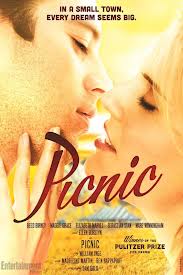
'Picnic': Sparks But No Fireworks in Tame Revival


Where is James Dean when you need him?

That’s what I was thinking as I watched the workmanlike if uninspired production of William Inge’s 1953 Pulitzer Prize-winning play, Picnic, now in previews at the American Airlines Theater. 

Inge’s domestic drama centers on a circle of family and neighbors in a small town in Kansas, where predictable lives are shaken up by the intrusion of an outsider, Hal. Hal is a combo pack of earthy masculinity, wild unpredictability, and  vulnerability that raises the temperature for the repressed women, already sweltering in the late summer’s heat. 

Before Hal (Sebastian Stan) shows up looking for work as a handyman, plans are underway for the annual Labor Day picnic, a final fling before the start of the new school year. 

We meet Flo Owens (Mare Winningham) and her daughters, the younger Millie (Madeleine Martin),“the smart one,” and her older sister Madge (Maggie Grace), 18, “the pretty one” whom Flo hopes to marry off to Alan (Ben Rappaport), a pleasant enough well-to-do college student with a bright future ahead of him. Madge and Alan do seem to be a well suited, albeit “safe” match, until Hal comes along.

As a dramatic character, Hal is the kind of young man who would have been portrayed in the movies by James Dean or Marlon Brando (though, as it happens, it was William Holden—arguably too old for the part—who famously took on the role in the 1955 film version of the play).

Hal has been hired to do chores for the Owens’ neighbor Mrs. Potts (Ellen Burstyn). He reminds her of her own rebellious days, and his frequently-on-view shirtless hubba-hubba torso clinches the deal.

As evening descends, it isn’t long before pretty girl Madge and pretty boy Hal get together, and sparks begin to fly.  Let’s just say, in appropriately 1950s euphemistic terms, they never do make it to the picnic.   

The story of Hal and Madge has its counterpart with that of an older couple, Rosemary (Elizabeth Marvel), a spinster school teacher who boards with the Owens family, and her beau Howard (Reed Birney), whom she is determined to marry before she has to face one more day in the classroom. 

The production, efficiently directed by Sam Gold, boasts solid performances by most of the cast.  Ms. Marvel and Ms. Burstyn are particularly compelling, despite the fact that their characters are built on clichés.

Unfortunately, in the central role of Hal, Sebastian Stan—best known for television and movie work (e. g. Captain America)simply does not have the acting chops to pull this off. While his abs are certainly ogle-worthy, Stan provides precious little of Hal’s wild streak, and the heat between him and Ms. Grace wouldn't boil a pot of tea.  

Theatergoers have an interesting opportunity to compare Inge’s work with that of Clifford Odets, whose Golden Boy is currently receiving a solid production a few blocks away at the Belasco. Where Odets contextualizes his play in broader social themes, Inge narrows his focus to life’s everyday dramas. 

In the right hands, domestic dramas can be quite potent. Think of Inge’s contemporary, Arthur Miller, or imagine what Tennessee Williams might have done with a character like Hal.  But in Picnic—at least as evidenced in this production—there is precious little at stake and not nearly enough combustion to trigger a drama-worthy flameout.  In the end, when Madge decides to chase after the departed Hal, the strongest sentiment she can muster is “he needs me,” and the best we can say to Madge is, “good luck."

Feel free to tell your friends about this blog, and to share your own theater stories by posting a comment.